Recent developments on the main server have brought both leadership changes and a restructuring of the tribunal system.
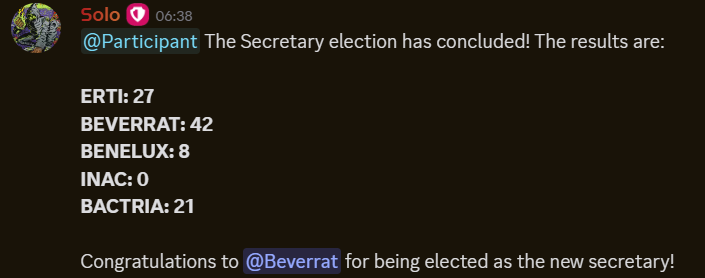
The Secretary election has officially concluded, with Beverrat elected as the new Secretary after receiving the highest number of votes. The final results showed Beverrat with 42 votes, followed by ERTI with 27 votes and Bactria with 21 votes. Benelux received 8 votes while INAC received none. The Secretary role is an important administrative position on the server because it is responsible for organizing and managing elections, ensuring that voting processes run properly.
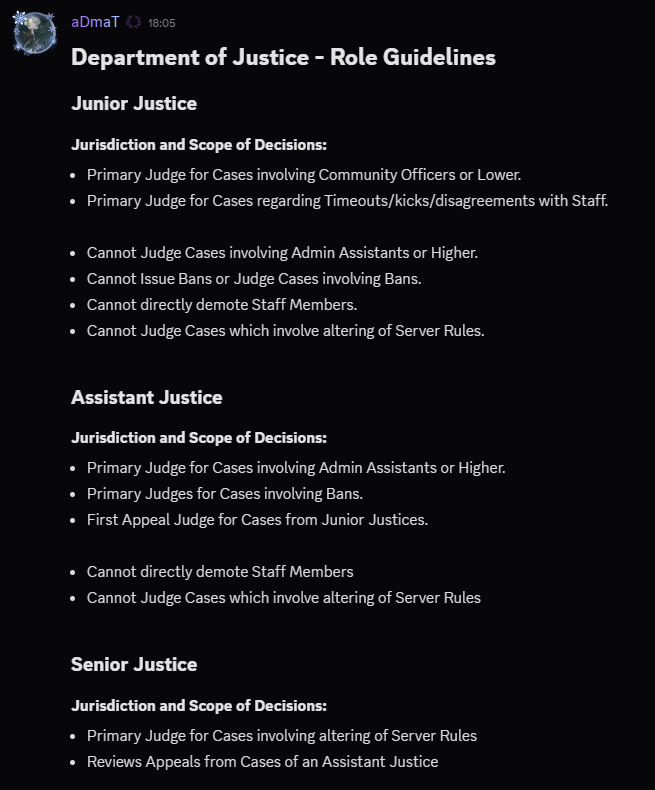
At the same time, the Department of Justice has released updated tribunal role guidelines that clarify how different justice roles handle cases. The system now assigns different types of cases to different judicial levels. Junior Justice acts as the primary judge for cases involving Community Officers or lower roles and also handles disputes related to timeouts, kicks, and disagreements with staff. However, Junior Justices cannot judge cases involving Admin Assistants or higher, cannot issue bans, cannot demote staff members directly, and cannot judge cases that involve altering server rules.
Assistant Justices operate at a higher level in the tribunal system. They are responsible for judging cases involving Admin Assistants or higher staff roles and also act as the primary judges in cases involving bans. In addition, they serve as the first appeal authority for cases that were originally judged by Junior Justices. Despite these responsibilities, Assistant Justices cannot directly demote staff members and cannot judge cases that involve altering server rules.
A new and more prominent role within the tribunal structure is Senior Justice. This role acts as the primary judge for cases that involve changes or alterations to server rules. Senior Justices also review appeals from cases that were previously judged by Assistant Justices, placing them higher in the judicial hierarchy.
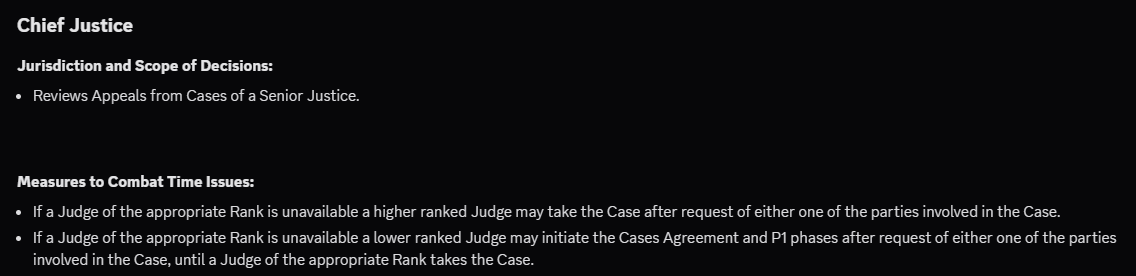
At the top of the tribunal system is the Chief Justice, who reviews appeals from cases handled by Senior Justices. The guidelines also include measures to address situations where a judge of the appropriate rank is unavailable. In such cases, a higher ranked judge may take over the case if requested by either party involved. Alternatively, if the correct rank is unavailable, a lower ranked judge may initiate the case agreement and early phases until the appropriate judge becomes available to take over the case.
The updated guidelines also outline the decision making power across roles within the tribunal system. The Creator holds the highest decision making power level at 10, followed by Chief Justice at 9, Senior Justice at 8, Assistant Justice at 7, Admin at 6, Admin Assistant at 5, Junior Justice at 4, Community Officer at 3, Community Helper at 2, while other roles hold no direct decision making power in tribunal decisions.
These updates introduce a clearer judicial structure within the server, defining how different roles manage cases and appeals while also formalizing the hierarchy of decision making authority.